Art
Marco Baragli’s Academic Review of Giuseppe Lucca’s Artisticamente abita l’uomo
In the following review, Marco Baragli offers a compelling and insightful reading of Giuseppe Lucca’s Artisticamente abita l’uomo, highlighting its philosophical depth, symbolic richness, and its humanistic vision of art.
Introduction
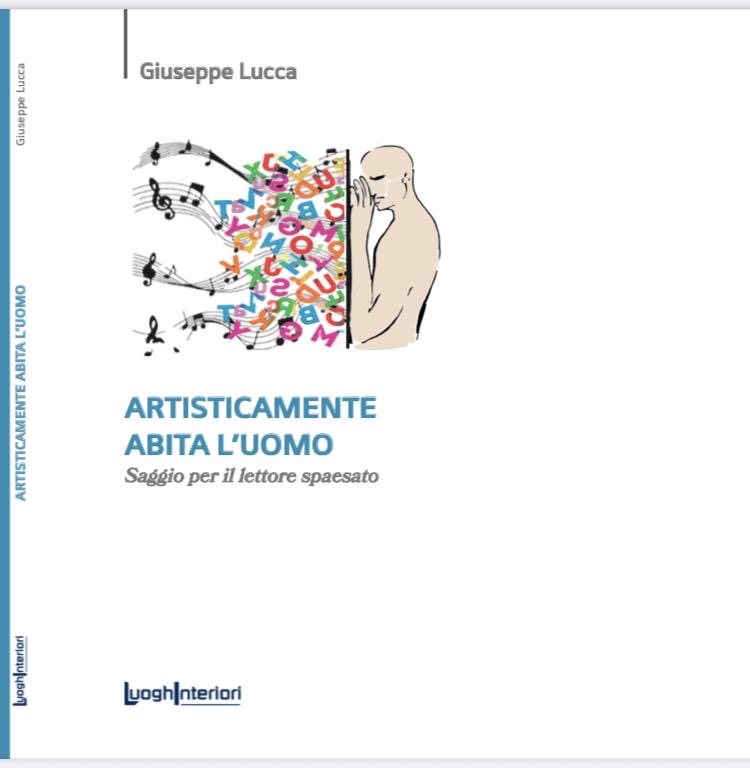
With *Artisticamente abita l’uomo*, Giuseppe Lucca crafts an essay that gracefully aligns with the trajectory of contemporary humanism, offering readers a cultured and multilayered journey into the nature of art. The author guides the “disoriented reader” through the forms of artistic knowledge, weaving together threads of aesthetic thought with philosophical, symbolic, and meta-artistic reflections. Through prose that blends clarity of exposition with conceptual sophistication, the essay serves as a guide to aesthetic experience, bringing the artwork closer to a cognitive and spiritual tension, without ever sacrificing complexity.
Philosophy of Art: Man as Artistic Essence
The philosophical foundation of the essay lies in the conviction that art is not merely representation, but an epiphany of the human. Lucca revisits and expands upon Hölderlin’s idea—“poetically dwells man upon this earth”—and places it as the keystone of an aesthetics of totality. In this framework, art is both subjective and objective, imaginative and rational, unconscious and technical. It is, therefore, the privileged mode through which man inhabits reality, expressing his essence in symbolic and processual form.
Lucca also evokes the tension between impulse and reflection, recalling the anthropological dualism dear to Henri Bergson: the left hand of intuition and emotion, the right hand of technique and rationality. For Lucca, art arises from their harmonious reconciliation. This position transcends the modern dichotomy between feeling and intellect, situating itself within the post-Kantian tradition of aesthetics as synthesis. The thought of Luigi Pareyson on the “formative” nature of art is implicitly referenced: the artwork both forms and informs, shaping author and reader alike.
In Lucca’s view, art is also embodied gnoseology. As Jerome Bruner suggests, artistic metaphor transcends the limits of ordinary experience, becoming a form of knowledge that unifies emotional life and its representation. Aesthetic education thus becomes a philosophical proposal: not elitist, but formative, capable of compensating for the limits of science and metaphysics, and of restoring to man “what is rightfully his: himself.”
Symbolism and Metaphor: Form as Revelation
A salient aspect of the essay is its focus on symbolism as a key to interpreting the artwork. For Lucca, every work speaks not only through direct language, but through signs, numbers, spatial relationships, and intertextual references. The author does not confine himself to aesthetic analysis but deciphers hidden intentions—the “poetic coordinates” that shape the structure of the work.
The section dedicated to Johann Sebastian Bach is emblematic: Lucca reads the E-flat fugue from the *Clavier-Übung* as a tripartite Trinitarian structure, reflecting theological perfection. The number 3, repeated and varied in bars, sections, tonalities, and numerical signatures, becomes both a compositional and spiritual symbol, in dialogue with Christian theology. In Bach, according to Lucca, “nothing is accidental”: even the number 14 in his name, the distribution of chorales, and the construction of the *Mass in B minor* are encrypted testimonies of a symbolic worldview.
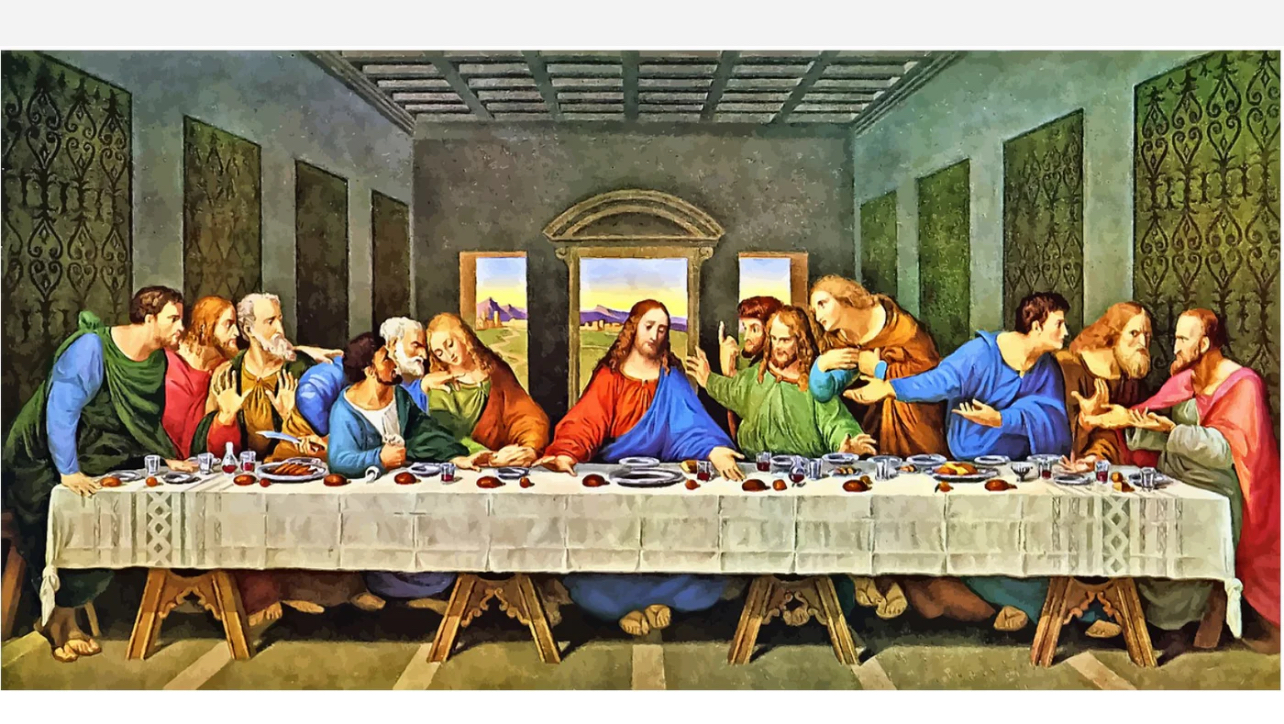
Similarly, in his reading of Leonardo’s *Last Supper*, Lucca identifies a rich network of numerical and geometric references—the groups of three apostles, the centrality of Christ, the triangular symmetry—as visual theology. The painting is not seen as mere representation, but as a symbolic structure that conveys meaning, alludes to harmony between heaven and earth, and evokes the Apocalypse through numerical multiplication.
Even in sacred architecture, the author deciphers hidden symbolic language: the ascent toward the inclined altar is read as a figure of Calvary, the sloped floor as a metaphor for purification, the transverse table as an image of the suffering Christ. Lucca insightfully shows how even the simplest structures—a mountain chapel, a monastic refectory—carry profound ascetic symbolism.
Humor as Spiritual Dialectic
The third chapter delves into a refined reflection on humor, understood not as comedy but as a form of intelligence about reality. The author revisits Pirandello’s theory of the “feeling of the opposite,” distinguishing between awareness of the opposite (external comedy) and feeling of the opposite (tragic revelation). Humor is thus a form of reflection that challenges impulse and unmasks it.
In this context, Don Abbondio is read as the quintessential humorous figure: the embodiment of the opposite of the priestly ideal, loved by Manzoni precisely for his weaknesses. Pirandello, in turn, constructs characters who oscillate between multiple identities: Mattia Pascal, *One, No One and One Hundred Thousand*, Maraventano. The humorist, for Lucca, is a thinker “without definition”: his judgment is always suspended between instinct and reflection, form and incoherence, body and shadow.
One of the most surprising sections is devoted to humorous cinema as a spiritual form. Lucca analyzes Buñuel’s *The Phantom of Liberty* as a metaphysical parable, where desecration—monks playing poker with holy cards, guests seated on toilet bowls at a dinner table—is interpreted not as mere provocation, but as symbolic dialectic: the final ostrich burying its head in the sand becomes an icon of modern man evading truth.
The Artwork as Dwelling
In the concluding chapter, the author returns to the central intuition: the artwork is poetic dwelling in the world, as the title suggests. This dwelling is not static but processual: the work is constructed by the author, but also by the reader-interpreter who “re-reads” it, reactivates it, inhabits it anew. The reference to Pirandello’s *Tonight We Improvise* is emblematic: only by dissolving form into lived experience can the artwork renew itself over time.
Art is thus not an end in itself, nor decoration: it is cognitive and spiritual movement. It may begin with impulse, irony, invention, but must arrive at a completed form. This form is always symbolic: it speaks through images, notes, geometries, verses, gestures.
Conclusion: Critical Judgment
Giuseppe Lucca’s essay represents a successful synthesis of theoretical rigor, interpretive sensitivity, and passion for the artwork. His vision is philosophical but never abstract; symbolic but never esoteric; cultured but never self-referential. The author constructs a deeply humanistic system of thought, where art becomes a site of knowledge, a reflection of the soul, and a manifestation of being.
“Artisticamente abita l’uomo”_ is therefore an essay that deserves to be read and reread—for the clarity of its conceptual framework, the originality of its interpretations, and the ethical and poetic tension that permeates it.**
About Marco Baragli
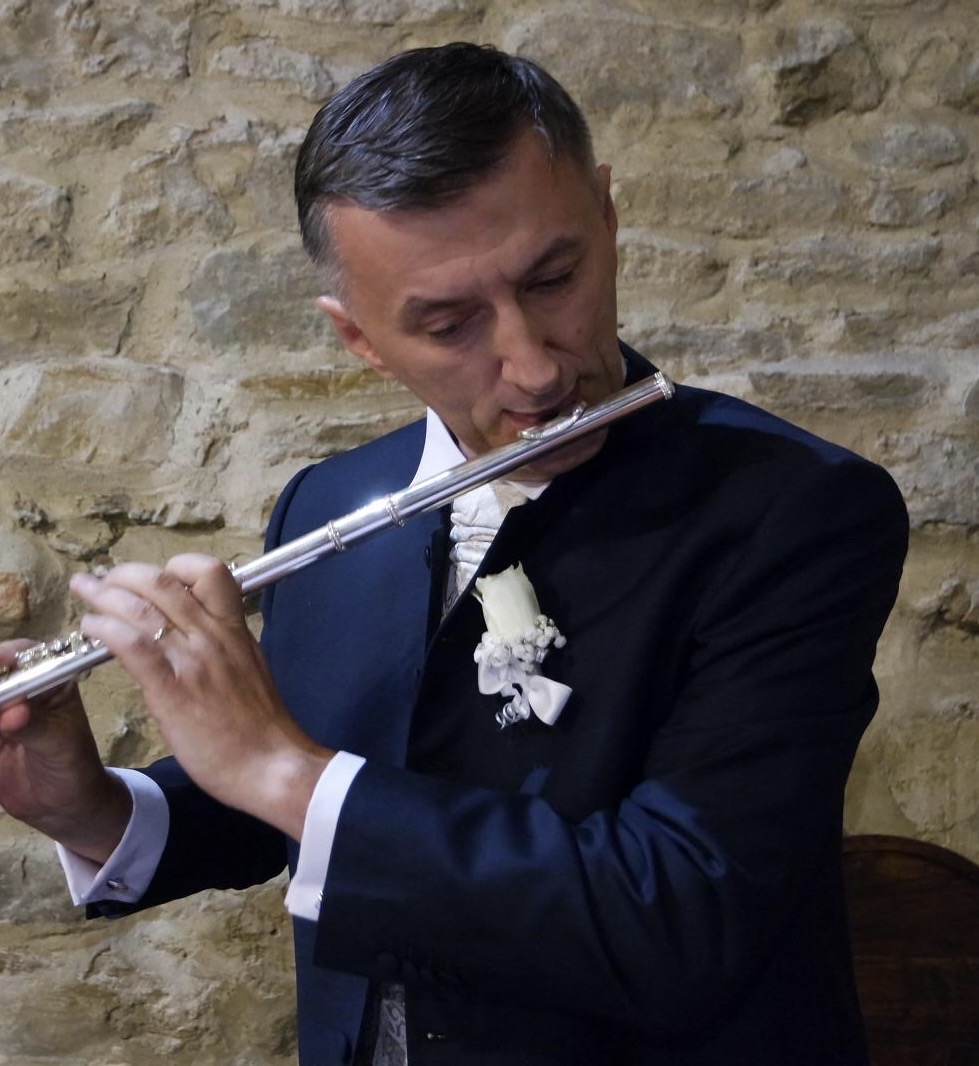
Marco Baragli is an Italian musician and scholar with degrees in Theology, Philosophy, and Flute. An acknowledged expert in symbolism, he was for several years a member of the Association of European Symbolists. His academic work includes numerous articles for prestigious journals, and his writings have been cited in internationally significant publications, as certified by Academia.edu.
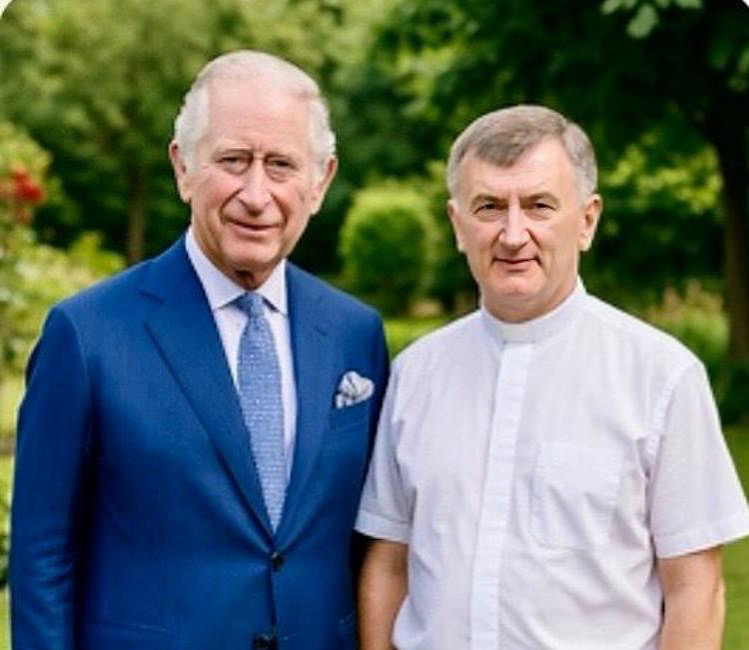
Baragli is the driving force behind Trinity of Sound, an innovative project created in collaboration with renowned Italian soprano Laura Ansaldi. Trinity of Sound is a symbolic and musical journey that unites Voice, Breath, and Key as archetypes of human expression, transforming each piece into an act of inner contemplation. In 2023, Marco Baragli had the honor to perform at the Coronation of King Charles III in England — a historic event witnessed across the globe.